
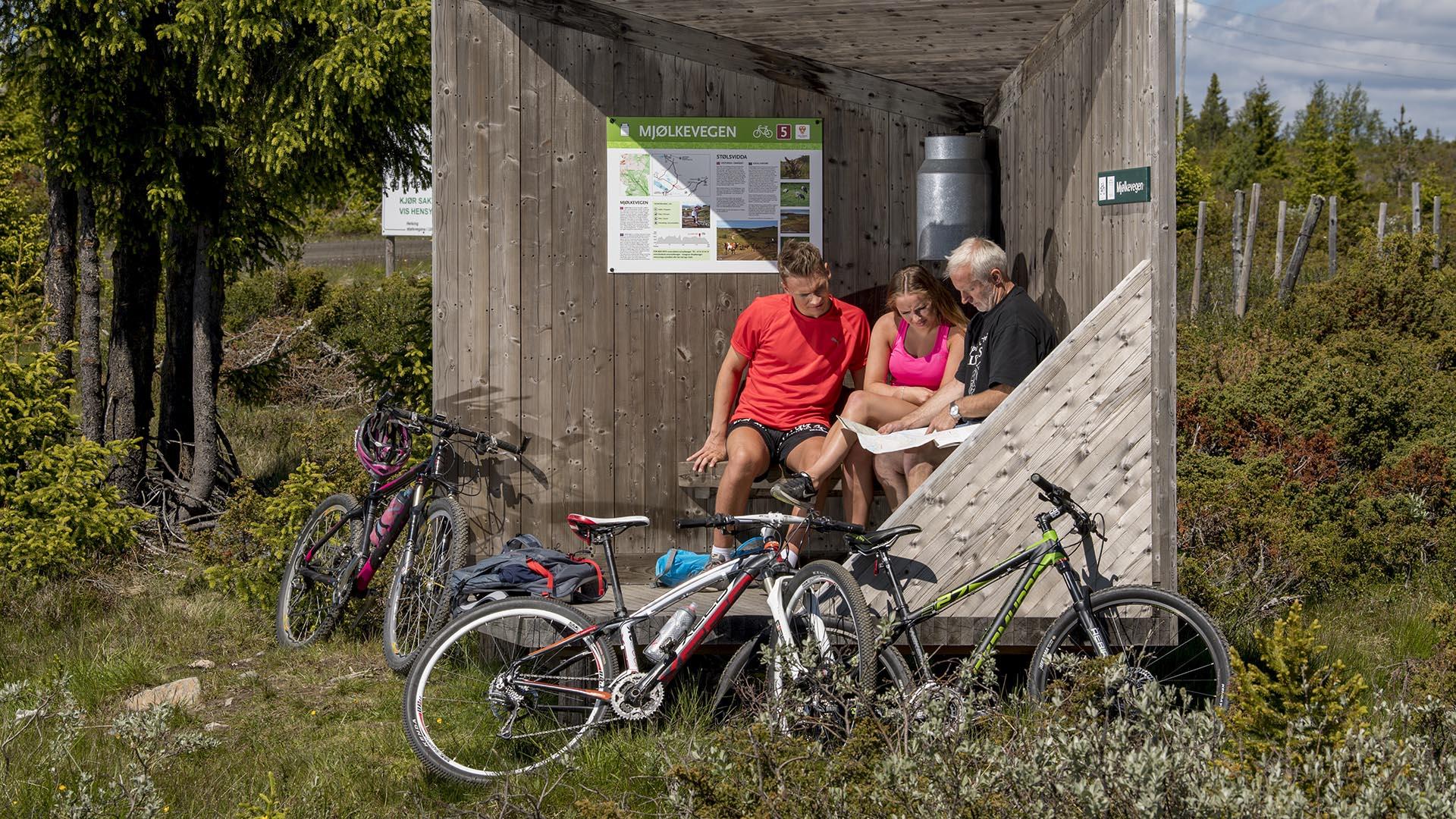
Welcome to one of Norway's greates bicycle routes!
Mjølkevegen crosses though Norway's most extensive summer mountain farm areas, using a unique network of mountain roads that were (and are) used to collect the milk from the summer farms, hence the name "Mjølkevegen" (Milk route). In spite of seemingly being close to civilization, Mjølkevegen offers great natural experiences, remote mountain terrain and phantastic cultural landscape in the farmland areas. It also is an area of rich biodiversity which needs to be protected and maintained for future generations.
Here are answers to the most frequently asked questions about Mjølkevegen. However, if you don't find the information you're looking for, please do not hesitate to contact us at info@visitvaldres.no!
* Mjølkevegen-code:
Thank you for helping in taking care of this natural landscape and contribute to it being preserved as a pristine hideout for locals and visitors alike by
- keeping nature free of waste. In addition to being unpleasant, waste potentially can harm animals. Dispose of your waste at the next waste container along the route. You can find a map of waste deposit stations in Valdres
ere: https://sortere.no/kart/kommune/Nord-Aurdal.
(The milk buckets in the Mjølkevegen rest shelters are decoration, not waste bins.)
- not using nature or private property as a public toilet. It can be far between serviced establishments, but please use these for this kind of need.
There are two pit toilet along Jotunheimvegen; one at Raudskaret and one at the information point for Langsua National Park at Veslfjell. Along Slettefjellvegen, Slettefjellkiosken at the southern entrance offers a guest toilet (fee) during the summer holidays, and along Vennisvegen you find a pit toilet at the parking lot by the water mills at the Leine river. The summer farms do not have guest toilets.
- giving livestock and wildlife space and treating them respectfully. Animals have the right of way. It may be very tempting to hold high speed on the superb quality of the gravel roads, but when encountering wildlife and livestock along the route, riders are required to reduce speed and give space.
- seeing further down for information on how to behave in meeting with cattle and for camping.
* Signage
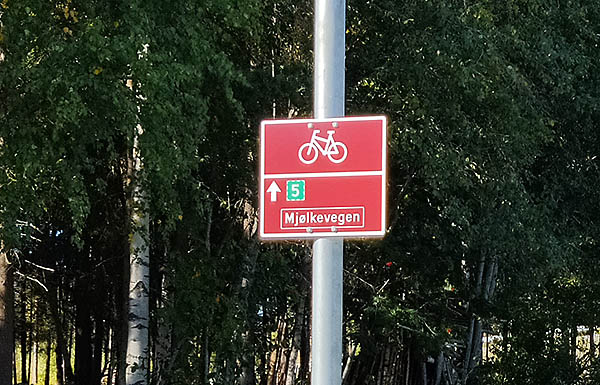
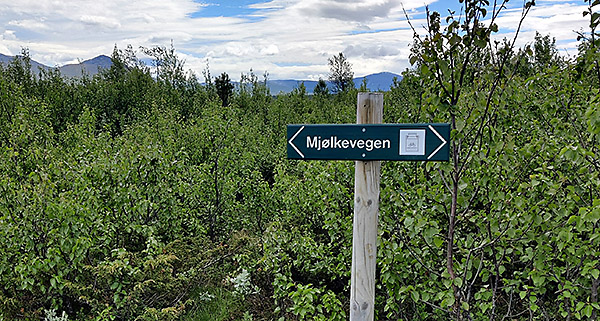
Mjølkevegen is well signed in both directions between Gol in the south and Skåbu/Ruten in the north. Between Gol and Golsfjellet west you'll encounter red-brown metal signs, whereas the rest of the route has dark green wooden signs. All critical junctions and points are supposed to have a clear sign. However, with a few specific exceptions all signs just say "Mjølkevegen" and point either direction. It is your responsibility to know where you are and in which direction you're headed. Make sure to carry a GPS and a good map to orientate yourself!
We check the signage once a year before the season, but signs can fall, get knocked over by cattle, snow plows, mowing machines or the occasional unlucky lorry driver, a screw can loosen resulting in the sign hanging upside down and sometimes they mystically simply disappear completely. If you encounter signes that are damaged or missing, we greatly appreciate if you send us a message with an as accurate position as possible.
* Transport options in and out of the route
By train:
To Vinstra and back from Gol or vice versa. If you need to rent a bike, Jotunheimen Bike & Hike can hand over bikes at Vinstra station on request. Be sure to agree on the return point to ensure the bike gets back to them. Tips: There are bookable tour packages that include rental bikes and transport.
By car and your own bike:
Parking at Vinstra or Gol respectively and return by public transport to your car after the finished tour:
- 1) by train via Oslo
- 2) by bus between Gol and Lillehammer (changes at Fagernes and Dokka) and then by train between Lillehammer and Vinstra. You can check connections at entur.no (but be aware that while the connections for all services are displayed, only tickets for regional services are sold in the app)
During the summer holidays you can take the bus from Fagernes or Beitostølen to the alternative starting point Lemonsjø Fjellstue. Mjølkevegen is signed from there, ans the first stage then leads through the Murudalen Valley to Ruten Fjellstue/Skåbu.
There are long term parking possibilities (on your own risk) at Fagernes St1 station and at Beitostølen; at the Tesla charging station 300 m from the town centre along Beitestølsvegen on your right where (against fee).
By bus:
During the summer holidays, there are bus services along road 51 from Fagernes and Beitostølen to Gjendesheim and further to Lemonsjø (see above) to start there. There are three different bus companies serving this route, and there is very limited capacity for bicycles. You can check connections at entur.no (but be aware that while the connections for all services are displayed, only tickets for regional services are sold in the app).
The best way to finish in the south is then by cycling from your last accommodation at Golsfjellet to Fagernes. Ask us for the route discription and GPX track to avoid the main road 51! From Fagernes there are multiple connections daily to Oslo and a couple to Bergen or Lillehammer, but be aware of limited capacity for bicycle transportation.
Bicycle reservation on a bus is only possible for Norway Busekspress services.
* How early/late in the season can I cycle Mjølkevegen?
The southern parts of the Mjølkevegen cycling route (roughly betweeg Syndinstøga and Gol) can be ok to cycle already from the end of May; the whole route is doable from when the pass road over Slettefjellet opens, approx. in the middle of June. Be aware that most accommodations and other services do not open before approx. June 23 (start of the summer holidays). See also below under road standard.
The season for the route alternative via Tyin follows the boat season on Lake Bygdin (from approx. the end of June to the beginning/middle of September). Dirt roads can be heavy to cycle when wet and soft. Please bear in mind that the situation can vary from year to year and depends largely on the amount of snow, temperatures and the melting process during spring.
Mjølkevegen over the Slettefjell pass can be cycled in the autumn until the snow arrives, but some accommodations and eateries can have have reduced opening hours in weekends only or close completely for the season already before the autumn holidays in the beginning of October.
Cycling off season can be very rewarding but also challenging in wet and cold weather and with reduced availability. If you have not booked a cycling package, please check ahead and make reservations or be prepared to manage on your own.
* Road standard: What kind of roads does one cycle on?
In general Mjølkevegen leads along firm gravel roads with limited/moderate motorized traffic. Shorter stretches are on tarmac roads or single trails. Gravel roads and trails can get soft and muddy, especially after snow melting (early in the season) and after heavy rain. Early in the season road damages from melt water are fixed with a layer of loose gravel, making it a bit more challenging (and dusty) to cycle on.
There are a few trail sections where you have to be prepared to push your bike. Examples are along the King's Road between Tyinkrysset and Øye, a 2 km stretch between Viksyndin and Nørdre Trøllhøvd (between Syndinstøga and Vaset), as well as on the eastern hillside of Golsfjellet as well as partly across Golsfjellet.
The tarmac sections are on country roads, regional roads or by choice on the E16:
- between Vinstra and Fefor for route choice via Ruten
- between Vinstra and Skåbu for route choice via Skåbu
- between Randsverk and the Sjoa bridge in Murudalen for start/end at Lemonsjø
- along road 51 between Bygdin and the northern side of Slettefjellvegen (via Beitostølen) for the Slettefjell-alternative
- from Tyin to Øye and from Vennis to Slettefjellkiosken for the Tyin-alternative
- between Høre and westside of Ryfoss
- between the western side of Golsfjellet and Gol
and vice versa.
* Trailer: Can I cycle Mjølkevegen with a trailer/trolley?
It is possible to cycle Mjølkevegen with a trailer/trolley, but you would have to take detours around the trail sections (see above). Contact us for more details.
* On tour with an e-bike; what do I have to consider and where can I recharge my batteries?
Running out of power is the biggest hassle with e-bikes, but the key is good planning. The longest uphill sections that can drain batteries quickly are from Ruten to the highest point along Jotunheimvegen (the saddle close to Buhøa), the mountain pass over Slettefjellet, and the climb from Ryfoss to Syndinstøga. On those stretches, please use your "e" with care and as a supplement only. If coming from Tyin, instead of Slettefjell, beware of a longer climb from Lake Vangsmjøse and up to to Hensåsen.
Charging stations along the route are:
- The Filefjell Tourist office/Intersport store at Tyinkrysset - inside or, if closed, outside on the wall close to the garbage containers. You may borrow Shimano, Bosch and Yamaha chargers
- The Beitostølen Tourist office at Velkomstsenteret in the centre of Beitostølen
- Slettefjellkiosken: 6 contacts for charging of e-bikes against fee
- At Gol: In the tourist office and at the Tesla charging station along road 7
- At all Mjølkevegen-accommodations along the route for guests
* How should I behave if I encounter cattle on my cycling tour?
The Mjølkevegen cycling route leads through the largest area in the country with actively run mountain farms. Free grazing livestock can be encountered almost anywhere along the route; sheep, goats and cattle. If you encounter a free grazing herd of cattle we recommend following the “cattle code”, given by the organizations Norsk Friluftsliv, Norges Bondelag and Tine, a.o. We sum it up here:
- Dismount your bike. Keep a distance to the animals and go around the herd.
- Don't go inbetween the animals. Cattle are inquisitive and can be obtrusive. They can create unwanted situations.
- Don't approach calves. Mother cows are very protective and can charge.
- Dogs should not be taken near cattle. If you cycle Mjølkevegen with a dog, keep it on a leash at all times until 20. August (general period when dogs must be leashed). Please note that some municipalities can have a prolonged leash period until October. Keep yourself informed.
- Cattle are inquisitive. If they become obtrusive, put down your bicycle and retreat calmly. Wait until the herd has moved on before you return to your bike and continue your cycling tour.
- If you pass through gates, remember to close them behind you in order to avoid giving the animals access to areas where they are not supposed to be.
* Can I sleep in a tent along Mjølkevegen?
Mjølkevegen is not recommended as a free camping route. There are great roofed accommodations, offering riders a good bed for the night and delicious, often regional, food as well as other amenities like washing stations, dryings rooms, locked bike storage and power outlets for charging. If you want to pitch a tent, you can find the following camp sites/camp grounds along the route:
- Randsverk Camping at the alternative start/exit at Lemonsjø
- Arctic domes at Bygdin Høifieldshotel
- First Camp Beitostølen
- Rogn Camping
- Vaset Camping
- Rest shelter Gauklivegen
- First Camp Gol
If you are exiting towards Fagernes instead of Gol, there are camp grounds found in Tisleidalen (Bjørkestølen Helårscamping, Vasetdansen Camping), Leira (Strandheim Hyttetun og Valdres Camping) and Fagernes (Fagernes Camping).
Mjølkevegen differs from other popular biking routes in leading through vast, private and active mountain farming land which on one hand contributes greatly to the route's attractivenes but on the other hand demands special consideration and respect from cyclists. There are free roaming sheep, goats and cattle in the whole area. Especially cattle are large, inquisitive and can be obtrusive. They like to flock around tents, lick on them and can stamp them. Cattle can turn up out of nowhere basically anywhere along the route.
Water from lakes, rivers and streams along the route should not be consumed untreated.
* Can I drive the route with a motorbike?
Mjølkevegen is a cycling tour but leads mainly along private roads that are open to motorized traffic (various toll fees apply). It is therefore possible to drive along the route, with a few exceptions where detours are necessary. This applies mainly to the trail sections between Viksyndin and Trollhøvd and on Golsfjellet. Also, with a motor bike you need to take the the route over Slettefjellet, as the boat on Lake Bydin is a passenger service only. Please drive responsibly and mind cyclists and animals along the road.
* Can I drive the route with a camper?
See the topic above. It is possible to drive along Mjølkevegen with a motorized vehicle (multiple toll fees apply) with a few exceptions where detours are necessary to avoid trail sections. With a camper you need to take the the route over Slettefjellet, as the boat on Lake Bydin is a passenger service only. Also, there are very limited possibilities to park your vehicle since the route leads through actively used farm and grazing lands. Please drive resposibly and mind cyclists and animals along the road.
For overnights, please see above under the topic "tent" for a list of camp grounds along the route.
Some of the Mjølkevegen hotels offer resonably prices parking on their property for RVs and motorhomes. If you bring bicyles, you can then explore parts of Mjølkevegen on day trips.
* Are there tour packages for Mjølkevegen that I can book?
We have created an overview over tour packages along the route that are available for booking. Here all your needs are taken care of and included - transport in and out of the route, bicycle rental, accommodation, meals, baggae transport, tour descriptions and GPS-files for the seperate legs. You can choose packages from different parts of the route, as well; the northern part, the southern part and special weekend-/family tour packages.
* Packing list:
The highest point of the route is at 1300 m.a.s.l. where the climate can change from friendly to rough and the weather is prone to sudden changes. In order to maintain the joy of cycling, it is essential that you have packed right.
- Long underwear and wind proof outer layer on your legs and body. Light down jacket for fast downhills, as well as a thin hat beneath your helmet and a pair of gloves. But just as well short-legged cycling pants and a T-shirt. Swimwear and a small towel for a dip along the road.
- There can be potholes, longitudinal cracks and bumps in the roads, especially early in the season after frost damages, and just like that you've rolled over. Always wear a helmet!
- If you cycle unsupported without baggage transport, use water proof bags or rain cover.
- It can be far until the next accommodation and even further to a medical doctor. Bring a basic first aid kit.
- Bring good shoes, either water proof shoes or water proof shoe covers.
- Always have a little ekstra energy easily available, such as an energy bar or some chocolate, and a warm drink in your thermos bottle. When exhausted, syrup or tea taste better than water.
- Bring water bottles and fill them up at your accommodation. Since cycling through farm land, water from streams or lakes should not be consumed untreated.
- A basic repair kit a with spare tube, extra break and a pump is always wise to have along remote gravel roads, even with a rental bike. There are great distances and it can take some time until help arrives.
- When using an e-bike, remember your charger. With a rental e-bike, learn how to use it.





Follow us on Facebook
Follow us on Instagram